

Select your language


We handle ongoing cloud maintenance and help you plan technical changes around your business needs, so your team can spend less time on infrastructure issues and more time on its core responsibilities.
Slow page loads, incorrect redirects, server errors and deployment problems hurt both usability and search visibility. Finding and fixing them early keeps the platform reliable for users and for search engines.
We address security risks as part of routine maintenance, helping detect and contain suspicious activity before it causes wider disruption to your systems or business operations.
Custom platforms, web applications and internal business tools need support from people who understand how they are built. We look for the root cause instead of relying on temporary workarounds, apply maintainable fixes, test them in the affected environment and document important changes.
Broken internal structures, indexing problems and other technical SEO issues reduce both usability and search visibility. We also troubleshoot analytics, tracking and reporting in tools such as Google Analytics.
We help keep your AI integrations and automations running reliably by troubleshooting problems and reducing risks to the stability and security of connected systems.
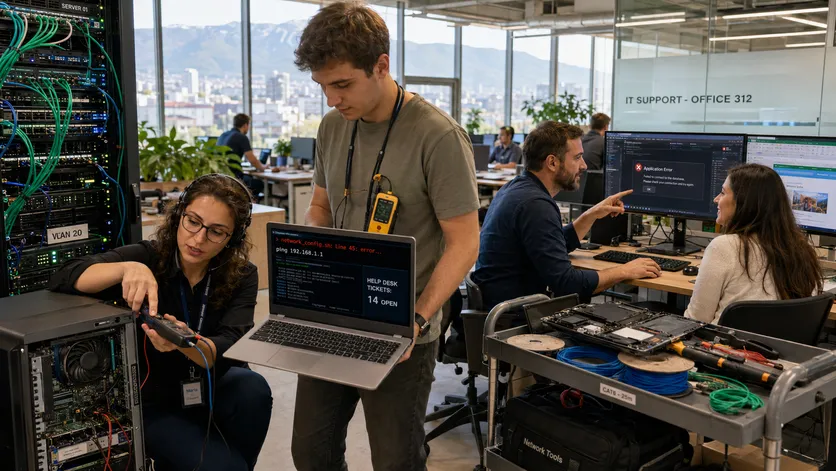
We investigate each issue, apply a fix and test the result. We document important changes and use urgency, security risk and business impact to guide the work at every stage.
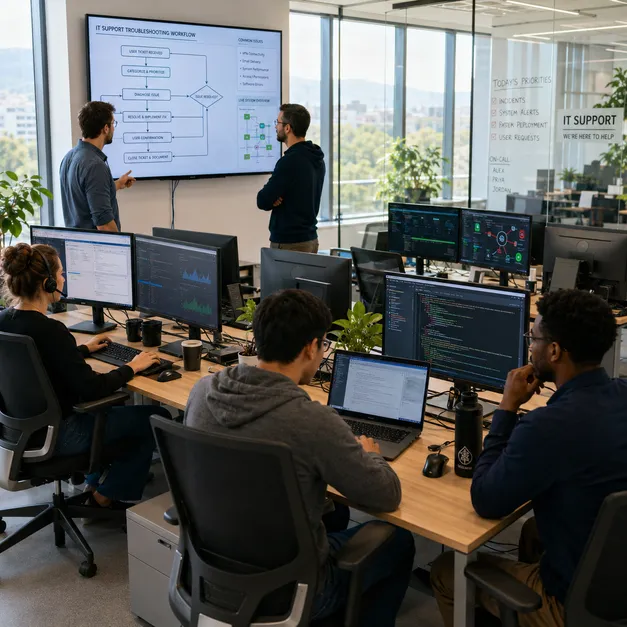


Both approaches are possible. A specific technical problem can be investigated as a standalone task, while businesses that depend heavily on their digital systems may benefit more from ongoing support.
The right arrangement depends on how critical the system is, how often changes are made and whether there is already an internal technical team. A relatively stable company website may need occasional assistance, while a custom platform handling daily operations usually requires more continuous attention.
Only the access required for the systems involved in the issue. Depending on the case, this may include a hosting environment, cloud account, server logs, source code repository, deployment pipeline, database, analytics platform or third-party service.
Access should follow the principle of least privilege wherever possible. Temporary or restricted accounts are preferable to sharing primary administrator credentials, and unnecessary access can be removed when the work is complete.
Yes. The service can supplement an internal development team, system administrator, hosting provider or another technical partner rather than replacing them.
For example, an internal developer may know the application well while additional expertise is needed to investigate infrastructure, deployment, security or performance problems. Responsibilities can be divided according to the issue so that several teams are not attempting to solve the same problem independently.
The investigation does not stop simply because the root cause is outside the application itself. The first step is to establish where the failure actually originates and collect enough technical evidence to support that conclusion.
If the problem belongs to a third-party provider, the relevant logs, error messages, request details and reproduction steps can then be prepared for escalation. This makes the conversation with the provider considerably more useful than simply reporting that something is not working.
Yes, although intermittent problems often require a different approach from errors that can be reproduced on demand.
Logs, monitoring data, request patterns, resource utilisation, deployment history and surrounding system events can be compared to identify what changes when the problem occurs. In some cases, additional logging or monitoring needs to be introduced first so that the next occurrence provides enough information to diagnose the cause.
The decision depends on more than the age of the technology. The important questions are whether the system can still be maintained safely, whether its dependencies remain supported, how expensive changes have become and whether its architecture is preventing the business from moving forward.
A system does not need to be rebuilt simply because something newer exists. If targeted improvements can make it reliable and maintainable, keeping it may be the better option. Replacement becomes more reasonable when recurring problems, unsupported technology or accumulated technical debt make continued maintenance increasingly risky or expensive.
We build enterprise software from early-stage startup idea.