

Select your language



Regular assessments show what is exposed and what to fix first.
Many weaknesses start during development: vulnerable dependencies, exposed credentials, weak input validation or insecure authorization logic.
Compromised credentials and excessive permissions can turn a small weakness into a serious incident.
Prevention reduces risk, but no environment should rely on it alone.
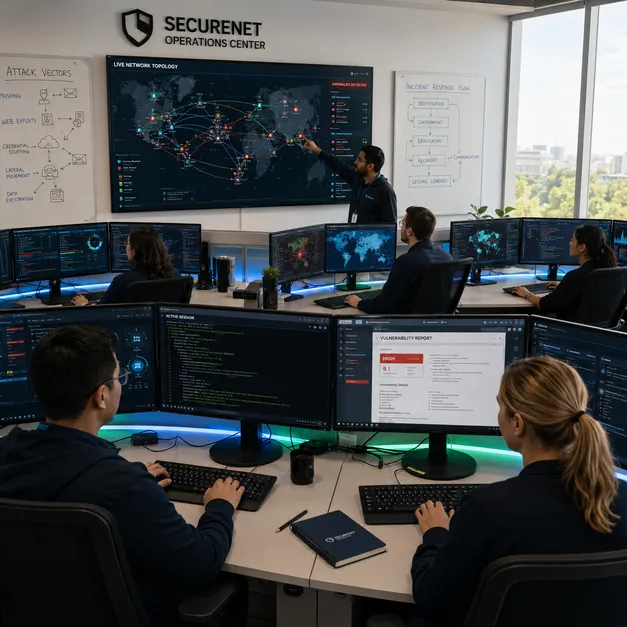


Alerts are useful when they explain what happened, which systems may be affected and what action should follow. Good detection helps your team focus on real security events instead of drowning in notifications.
We watch logs, authentication events, application behavior, infrastructure changes and network activity for signs of compromise.
We investigate the event, find the affected systems and isolate compromised accounts, applications or servers. Credentials and secrets are rotated when access may have leaked.
We restore affected systems safely and keep the logs and technical evidence the investigation needs.
A post-incident review finds the root cause, and the findings are used to improve your security controls.
New releases, dependencies, user accounts, integrations and cloud services can add risk even to a securely configured environment. Security has to change along with the systems it protects.
Yes, but whether production is the right environment depends on the application and the type of testing required.
Before testing begins, the boundaries are agreed in advance: which systems can be touched, which techniques are permitted, which actions must be avoided, and who should be contacted if something unexpected happens. Tests that could modify data, trigger external services, create large amounts of traffic, or interfere with normal users can be restricted or moved to a staging environment.
For many applications, meaningful testing can still be carried out against production without intentionally disrupting normal operation.
That depends on how much visibility the assessment is intended to have.
A public-facing assessment may begin with little more than the application or API endpoints. A deeper review may require test accounts with different roles, API documentation, selected configuration information, or access to source code.
Different access levels let us test different risks. Separate customer, manager and administrator accounts, for example, let us check whether a role can perform actions or access information meant for another.
Not necessarily.
Testing can be performed from the perspective of an external user with no internal knowledge, with authenticated user accounts, or with additional technical information such as source code and architecture documentation.
The appropriate level depends on the objective. If the goal is to understand what an unknown external attacker could discover, minimal access may be appropriate. If the goal is to find difficult authorization, implementation, or architectural problems before release, providing additional internal visibility can make the assessment considerably more thorough.
It does not have to wait until the application is finished.
A useful point is often before a major release, but testing is particularly valuable after changes that affect authentication, permissions, payments, APIs, infrastructure, sensitive data, or integrations with external systems.
For an established product, the decision can therefore follow changes in risk rather than an arbitrary calendar. A major change to how users authenticate may justify another assessment even if the previous one was relatively recent, while a minor visual update usually would not.
No security assessment can provide that guarantee.
A penetration test examines a defined set of systems under agreed conditions at a particular point in time. It can provide strong evidence about the weaknesses that were found-or were not found within that scope-but applications continue changing after the assessment is completed.
The assessment shows the current exposure, which risks need attention and where additional protection would help most.
It can be prepared with different audiences in mind.
Developers need enough technical detail to reproduce and correct a problem, while management is usually more interested in severity, business impact, affected systems, and remediation priorities. Customers, procurement teams, or auditors may require a higher-level summary without sensitive exploitation details.
Where appropriate, these can be separated so that technical evidence remains available to the people responsible for remediation without unnecessarily distributing information that could itself be security-sensitive.
We build enterprise software from early-stage startup idea.